Boost Workplace Productivity: The Nudge Effect Explained

In an increasingly competitive global landscape, organizations are constantly seeking innovative ways to enhance efficiency, foster engagement, and ultimately, boost their bottom line. While traditional methods often focus on incentives or strict regulations, a more subtle, yet profoundly effective approach is gaining traction: the nudge effect workplace. This powerful concept, rooted in behavioral science, offers a transformative lens through which to view and optimize employee behavior, promising a significant uplift in productivity – perhaps even a 10% increase by 2026.
The idea of nudging, popularized by Nobel laureates Richard Thaler and Cass Sunstein, suggests that by subtly altering the ‘choice architecture’ – the context in which people make decisions – we can guide individuals towards more beneficial outcomes without restricting their freedom of choice. Imagine a world where employees naturally gravitate towards more productive habits, make healthier choices, and collaborate more effectively, not because they are forced, but because the environment subtly encourages it. This is the promise of the nudge effect workplace, and it’s a strategy that astute leaders are beginning to harness.
Understanding the Nudge Effect: Beyond Incentives and Mandates
To truly appreciate the potential of the nudge effect workplace, it’s essential to grasp its core principles. Unlike traditional top-down directives or financial incentives, nudges operate on a more psychological level. They acknowledge that human beings are not always rational actors; our decisions are often influenced by cognitive biases, heuristics, and the way choices are presented to us.
Think about a simple example: placing fruit at eye level in a cafeteria subtly encourages healthier eating choices more effectively than a memo about healthy diets. In the workplace, this translates to designing environments and processes that make desired behaviors easier, more attractive, and more intuitive. It’s about leveraging insights into human psychology to create a ‘frictionless’ path towards productivity and well-being.
The Science Behind the Nudge
Behavioral economics, the field from which nudging emerged, combines insights from psychology and economics to understand why people make the choices they do. Key concepts include:
- Anchoring: Our tendency to rely too heavily on the first piece of information offered (the ‘anchor’) when making decisions.
- Framing: How the way information is presented (framed) influences our choices.
- Availability Heuristic: Our tendency to overestimate the likelihood of events that are more easily recalled or imagined.
- Loss Aversion: Our tendency to prefer avoiding losses over acquiring equivalent gains.
- Default Bias: Our inclination to stick with default options, even if other choices might be better.
By understanding these biases, organizations can strategically implement nudges to counteract unproductive tendencies and foster positive ones. The goal is not to manipulate, but to empower employees to make choices that align with both their personal and the organization’s goals.
Why the Nudge Effect is Crucial for Modern Workplaces
The traditional command-and-control model of management is becoming increasingly outdated. Today’s workforce values autonomy, purpose, and a positive work environment. The nudge effect workplace aligns perfectly with these modern values, offering a respectful and empowering approach to performance improvement.
Enhancing Employee Well-being and Engagement
Nudges aren’t just about output; they’re also about fostering a healthier, more engaged workforce. By subtly encouraging breaks, promoting ergonomic setups, or making mental health resources easily accessible, organizations can demonstrate a genuine commitment to employee well-being. This, in turn, leads to higher morale, reduced burnout, and ultimately, sustained productivity.
Driving Innovation and Collaboration
A well-designed nudge effect workplace can also stimulate creativity and cross-functional collaboration. Simple nudges, like rearranging office layouts to encourage spontaneous interactions or providing visible platforms for sharing ideas, can break down silos and foster a culture of innovation. When employees feel supported and connected, they are more likely to contribute their best ideas.
Achieving Sustainable Productivity Gains
Unlike short-term incentives that often lead to temporary spikes in performance, nudges aim for sustainable behavioral change. By making desired actions the ‘easy’ or ‘default’ choice, organizations can embed productive habits deep within their culture. This long-term approach is what makes the nudge effect workplace a powerful tool for achieving ambitious goals, such as a 10% productivity increase by 2026.
Practical Applications of the Nudge Effect in the Workplace
So, how can organizations practically implement the nudge effect workplace to achieve tangible results? Here are several key areas and examples:
1. Optimizing Workflow and Task Management
Many productivity challenges stem from inefficient workflows or poor task prioritization. Nudges can streamline these processes:
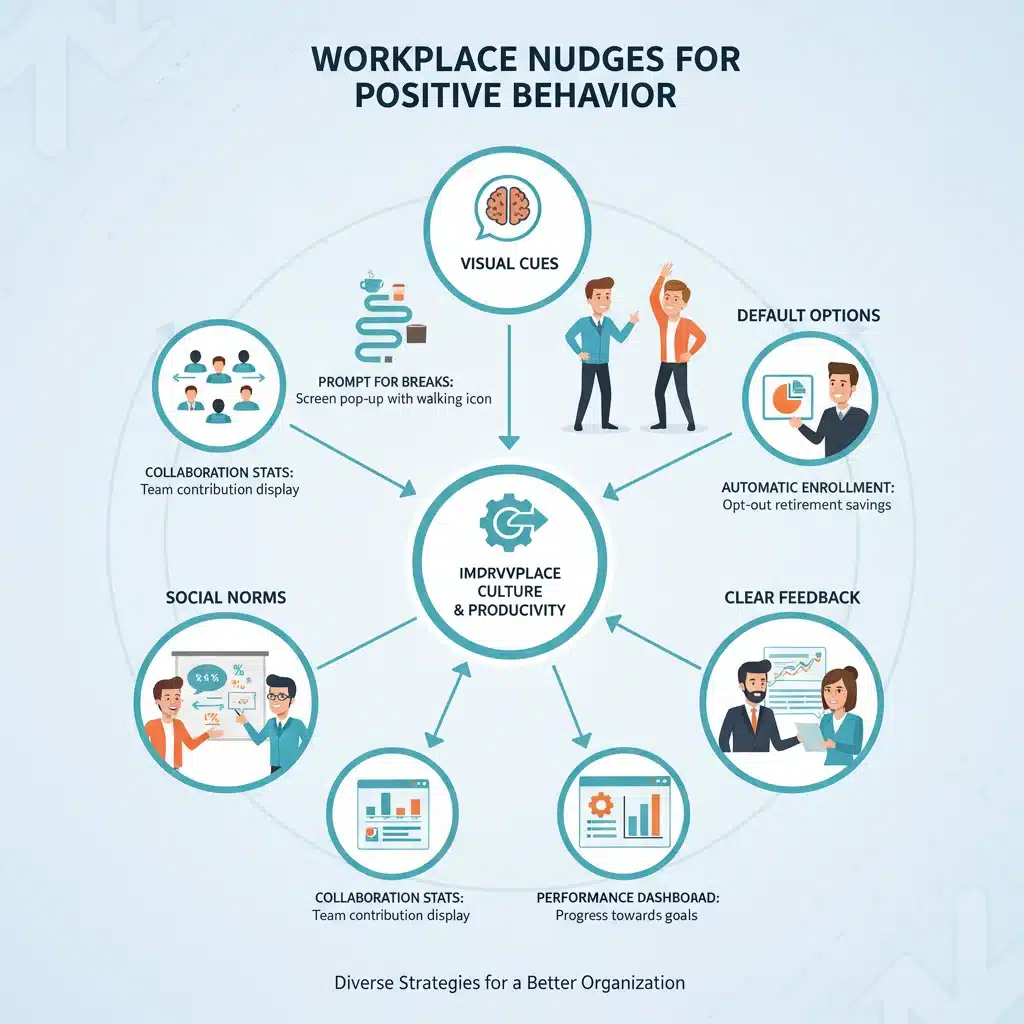
- Default Task Prioritization: Implement project management software where urgent and important tasks are automatically prioritized or highlighted, guiding employees to focus on high-impact work first.
- Micro-Break Prompts: Integrate subtle reminders within software or through smart office lighting to encourage short, regular breaks, combating fatigue and improving focus.
- Visual Progress Trackers: Display team or individual progress on shared goals prominently. The mere visibility of progress can serve as a powerful motivator (social proof and goal setting nudge).
- Batching Similar Tasks: Design systems that encourage employees to group similar tasks together (e.g., answering emails only at certain times) to reduce context-switching costs.
2. Enhancing Communication and Collaboration
Effective communication is the bedrock of a productive team. Nudges can facilitate better interactions:
- Meeting Agenda Defaults: Standardize meeting templates that require clear objectives and action items, nudging participants towards more focused and productive discussions.
- Proximity Nudges: Strategically arrange office furniture or assign seating to encourage interactions between different departments or team members who would benefit from collaboration.
- Feedback Loops: Implement easy-to-use, anonymous feedback tools that default to positive framing, encouraging constructive criticism and continuous improvement.
- Shared Knowledge Platforms: Make knowledge-sharing platforms the default repository for project documentation, ensuring information is readily accessible and reducing redundant work.
3. Fostering Employee Well-being and Development
A healthy and skilled workforce is a productive one. The nudge effect workplace can promote both:
- Healthy Snack Defaults: In office kitchens or vending machines, make healthy options more visible and easily accessible, gently steering employees away from less nutritious choices.
- Ergonomic Reminders: Provide software prompts or physical cues (e.g., adjustable desks that rise at certain intervals) to encourage ergonomic posture and movement.
- Learning & Development Prompts: Automatically suggest relevant training modules or learning resources based on an employee’s role or project, making professional development a natural next step.
- Work-Life Balance Nudges: Implement systems that gently remind employees to log off after core hours or encourage them to take their full vacation days.

Designing Effective Nudges: Key Principles
Implementing the nudge effect workplace isn’t about haphazard changes; it requires thoughtful design. Here are principles for creating effective nudges:
1. Define the Desired Behavior Clearly
Before designing a nudge, precisely identify the specific behavior you want to encourage. Is it better time management? Increased participation in training? Reduced energy consumption? Clarity is paramount.
2. Understand the Behavioral Barrier
Why aren’t employees currently exhibiting the desired behavior? Is it lack of awareness, inertia, cognitive overload, or social pressure? Understanding the underlying psychological barrier is crucial for designing an effective nudge.
3. Make it Easy, Attractive, Social, and Timely (EAST Framework)
The Behavioral Insights Team (BIT) developed the EAST framework for designing effective nudges:
- Easy: Reduce friction. Make the desired action the default or the path of least resistance.
- Attractive: Grab attention and make the desired action appealing.
- Social: Leverage social norms and peer influence. People are often influenced by what others do.
- Timely: Deliver nudges when people are most receptive or when they are about to make a decision.
4. Maintain Freedom of Choice
A true nudge never restricts choice. Employees should always feel they have the option to choose otherwise. The power of the nudge effect workplace lies in its subtlety and respect for individual autonomy.
5. Test, Iterate, and Measure
Nudging is an iterative process. Implement nudges on a small scale, measure their impact, and be prepared to refine or even discard them based on the results. A/B testing can be incredibly valuable here.
Case Studies: Nudge Effect in Action
Real-world examples demonstrate the power of the nudge effect workplace:
Google’s Cafeteria Nudges
Google famously uses nudges in its cafeterias to promote healthier eating. By placing smaller plates prominently, making healthy food options more accessible and visible, and labeling food with calorie counts, they subtly guide employees towards better dietary choices. This improves employee health and reduces healthcare costs.
Defaulting to Retirement Savings
Many companies have significantly increased employee participation in retirement savings plans by making enrollment the default option. Employees still have the freedom to opt-out, but the inertia of the default choice leads to higher participation rates, securing employees’ financial futures.
Energy Conservation in Offices
Some organizations have used smart thermostats that default to energy-saving temperatures or display real-time energy consumption data prominently. This transparency and default setting nudge employees towards more environmentally friendly behaviors, reducing operational costs.
Overcoming Challenges and Ethical Considerations
While the nudge effect workplace offers immense potential, it’s not without its challenges and ethical considerations.
Avoiding Manipulation
The line between nudging and manipulation can be fine. It’s crucial for organizations to ensure that nudges are always transparent, in the best interest of the employees, and never coercive. The goal is to help employees make better choices for themselves and the organization, not to trick them.
Context Matters
A nudge that works in one context might fail in another. Cultural nuances, organizational climate, and individual differences all play a role. Thorough testing and a deep understanding of the specific workplace environment are essential.
The ‘Backfire’ Effect
Sometimes, an ill-conceived nudge can backfire, leading to resentment or even the opposite of the desired behavior. For instance, too aggressive a social norm message might make individuals feel singled out. This underscores the need for careful design and iterative testing.
The Importance of Leadership Buy-in
For the nudge effect workplace to be truly effective, it requires buy-in from leadership. Leaders must understand the principles, champion the approach, and be willing to invest in the necessary design and testing phases.
The Future of Workplace Productivity: A Nudged Reality by 2026
As we look towards 2026 and beyond, the integration of behavioral science into workplace design will become increasingly sophisticated. The nudge effect workplace will evolve from a niche strategy to a fundamental component of organizational development and HR strategy. Imagine AI-powered nudges tailored to individual employee needs, promoting personalized learning paths, well-being interventions, and optimal work patterns.
The organizations that embrace this paradigm shift will be the ones that not only achieve impressive productivity gains but also cultivate a thriving, engaged, and resilient workforce. By understanding the subtle drivers of human behavior, they can create environments where success is not just encouraged, but gently, yet powerfully, nudged into being.
Conclusion: Embracing the Subtle Power of the Nudge
The journey to boosting workplace productivity by 10% or more by 2026 doesn’t necessarily require radical overhauls or massive financial investments. Often, it’s the subtle, well-placed interventions – the nudges – that yield the most profound and sustainable results. By strategically applying the principles of behavioral science, organizations can create environments that naturally guide employees towards greater efficiency, enhanced well-being, and stronger collaboration.
The nudge effect workplace is more than just a trend; it’s a sophisticated, human-centric approach to organizational design that respects autonomy while fostering positive change. It empowers leaders to become architects of choice, subtly shaping a future where productivity flourishes, not by force, but by intelligent design. Embrace the power of the nudge, and unlock a new era of workplace excellence.