Boost US Savings: Loss Aversion Strategies for 5% Annual Growth

Harnessing Loss Aversion: New Behavioral Strategies to Increase Savings by 5% Annually in the US
In the complex world of personal finance, saving money often feels like an uphill battle. Despite the best intentions, many individuals struggle to consistently set aside funds, leading to stagnant savings accounts and missed financial goals. But what if there was a powerful psychological lever that could dramatically change this dynamic? Enter loss aversion savings – a concept from behavioral economics that suggests humans feel the pain of a loss far more intensely than the pleasure of an equivalent gain. This fundamental principle offers a revolutionary approach to personal finance, particularly for those in the US looking to increase their annual savings by a significant 5% or more.
Understanding and strategically applying loss aversion can transform your financial habits from a burdensome chore into an almost automatic process. Instead of focusing solely on the ‘gain’ of future wealth, we can reframe savings around the ‘avoidance of loss,’ making the act of saving a more compelling and sticky behavior. This article delves deep into actionable behavioral strategies, rooted in loss aversion, designed to help you not just save, but thrive financially.
The Psychology Behind Loss Aversion and Its Financial Implications
Before we dive into specific strategies, it’s crucial to grasp the core psychological phenomenon of loss aversion. Pioneered by Nobel laureates Daniel Kahneman and Amos Tversky, loss aversion explains why, for example, people are more motivated to avoid losing $100 than they are to gain $100. The emotional impact of a loss is roughly twice as powerful as the emotional impact of a gain of the same magnitude. This isn’t just an interesting psychological quirk; it’s a hardwired aspect of human decision-making that profoundly influences our financial choices.
In the context of savings, this means that the prospect of ‘losing’ money by not saving it (e.g., losing out on potential investment gains, losing financial security, or losing a chance to achieve a goal) can be a far stronger motivator than the ‘gain’ of having more money in a savings account. Traditional savings advice often focuses on the positive aspects of saving – the future vacation, the down payment, the retirement nest egg. While these are certainly motivating, they often fall short because the ‘gain’ is distant and abstract. Loss aversion, however, taps into an immediate, primal fear, making it an incredibly potent tool for behavioral change.
For US households grappling with low savings rates, integrating loss aversion principles offers a fresh perspective. Instead of solely relying on willpower, which is a finite resource, these strategies build systems that leverage our inherent aversion to loss, making saving less about discipline and more about smart design. The goal is to create environments where not saving feels like a significant loss, thus propelling individuals towards their financial objectives with greater efficacy.
Strategy 1: The ‘Commitment Contract’ with Penalties for Non-Compliance
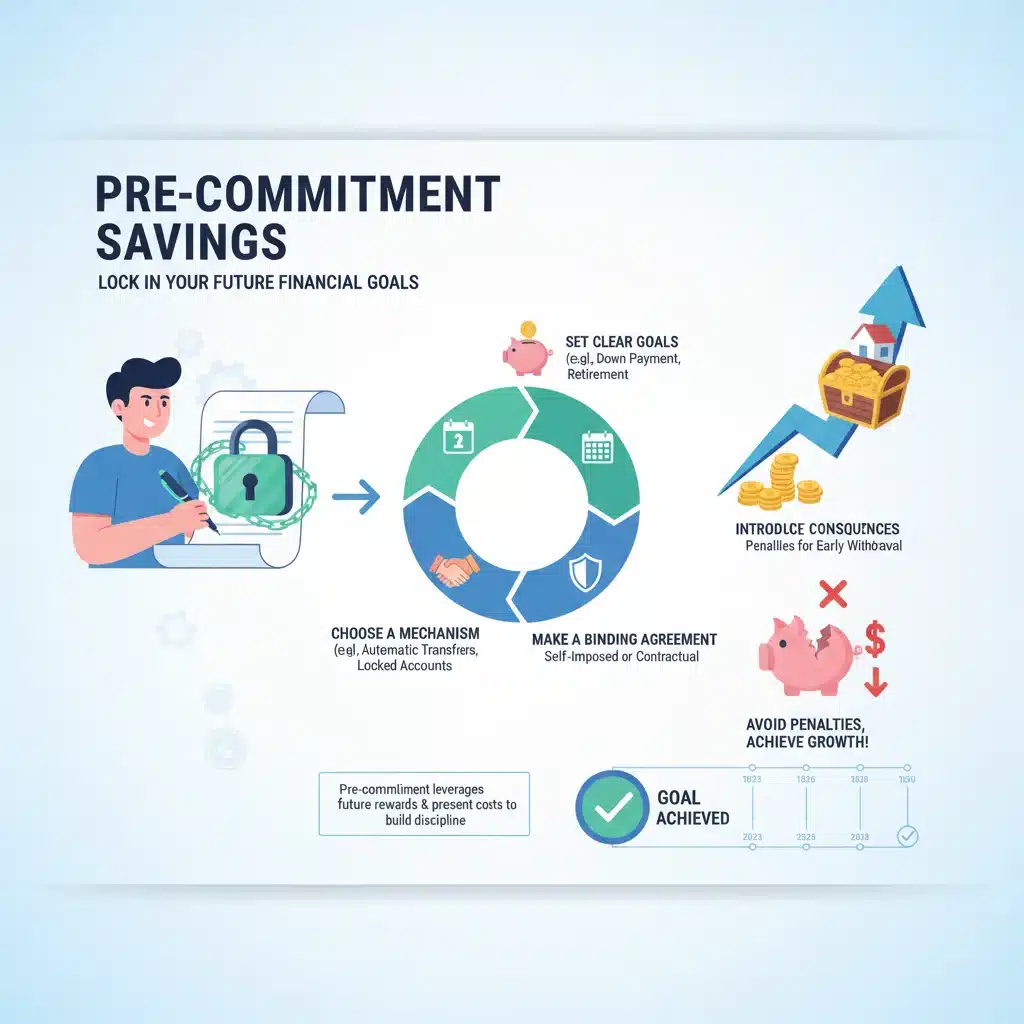
One of the most direct applications of loss aversion savings is through commitment contracts. This strategy involves making a binding agreement to save a certain amount by a specific date, with a predefined penalty if the commitment is not met. The penalty could be financial (e.g., a fee paid to a charity you dislike, or a deduction from your account) or social (e.g., publicly announcing your failure). The key is that the penalty must be genuinely painful enough to trigger the loss aversion mechanism.
Consider an individual aiming to save an extra $500 per month. They could enter into a commitment contract with a trusted friend or use a dedicated app designed for this purpose. The contract states that if they fail to transfer $500 to their savings account by the 25th of each month, they will automatically donate $50 to a political party they strongly oppose. The fear of this ‘loss’ (giving money to an undesirable cause) acts as a powerful deterrent against non-saving.
Several platforms and apps are emerging that facilitate such contracts. StickK.com, for instance, allows users to set up commitment contracts with monetary stakes, often involving ‘referees’ and ‘charities’ to which the money is forfeited if goals are not met. The effectiveness of this approach lies in externalizing the cost of failure, making the potential loss tangible and immediate, rather than a vague future regret. This can be particularly effective for boosting annual savings by 5% because it provides a strong, consistent push.
Strategy 2: Framing Savings as Avoiding Future Financial ‘Losses’
The way we frame our financial goals can significantly impact our motivation. Instead of saying, ‘I want to save $5,000 for a down payment,’ which focuses on a future gain, reframe it using loss aversion: ‘If I don’t save $5,000, I will lose the opportunity to buy my dream home and be stuck renting for another year.’ This shifts the psychological emphasis from a potential gain to an avoided loss, making the motivation much stronger.
This strategy can be applied to various savings goals. For retirement, instead of thinking ‘I want to accumulate $1 million for retirement,’ consider ‘If I don’t save adequately, I risk losing my financial independence in old age and being a burden to my family.’ For emergency funds, ‘Not having an emergency fund means I risk going into debt or losing my assets if an unexpected expense arises.’ The language used is critical here; it must evoke the pain of potential loss.
Financial advisors in the US can play a pivotal role in helping clients reframe their savings narratives. By guiding clients to articulate the specific ‘losses’ they would incur by not saving, advisors can tap into a deeper wellspring of motivation. This isn’t about fear-mongering; it’s about aligning financial goals with a fundamental human psychological bias to create more effective saving behaviors. Regularly revisiting these ‘loss’ scenarios can reinforce the commitment and make loss aversion savings a consistent driver.
Strategy 3: The ‘Save More Tomorrow’ (SMART) Program with Opt-Out Options
The ‘Save More Tomorrow’ (SMART) program, developed by Richard Thaler and Shlomo Benartzi, is a prime example of how behavioral economics, including loss aversion, can be used to increase savings. While primarily focused on inertia and present bias, its success can also be attributed to the subtle application of loss aversion through its ‘opt-out’ mechanism.
The SMART program encourages employees to commit in advance to increasing their savings rates with future pay raises. When the raise kicks in, the savings rate automatically increases. The genius of this system is that it leverages two key behavioral insights: first, people are more willing to save future income than current income (addressing present bias), and second, the default option (saving more) is powerful. Opting out feels like a ‘loss’ – a conscious decision to forgo additional future savings, which can be psychologically uncomfortable.
Many 401(k) plans in the US now incorporate elements of the SMART program, often with automatic enrollment and automatic escalation of contributions. For individuals, you can replicate this by setting up an automatic transfer from your checking to your savings account that increases annually or with each pay raise. The ‘loss’ here is the mental effort and potential regret of actively going into your banking app to reduce your savings contribution. Making the default option the ‘saving’ option significantly reduces friction and leverages loss aversion by making non-saving an active choice that feels like a setback.
Strategy 4: Gamification and Public Accountability with Negative Consequences
Gamification can make saving more engaging, and when combined with loss aversion, it becomes incredibly potent. Imagine a savings challenge where participants put up a small initial stake. If they fail to meet their weekly or monthly savings goal, they ‘lose’ their stake or a portion of it, perhaps to a communal pot or a pre-designated ‘penalty fund.’ The fear of losing that initial stake, however small, can be a powerful motivator.
Public accountability amplifies this effect. Announcing your savings goals to friends, family, or an online community creates social pressure. If you fail to meet your goal, you not only experience the internal pain of not achieving your objective but also the external ‘loss’ of face or reputation. This dual layer of loss aversion can significantly boost adherence to savings plans.
For example, a group of friends could start a ‘savings club’ where each member pledges to save a certain amount each month. If someone misses their target, they owe each other member a small, symbolic amount. The collective social pressure and the tangible ‘loss’ of money to peers can be incredibly effective. Apps that allow for social sharing of financial goals, or even private groups where members track each other’s progress, can facilitate this strategy, making loss aversion savings a community effort.
Strategy 5: The ‘Matched Savings with a Catch’ Approach
Many employers offer matched savings contributions to retirement plans, which is a fantastic incentive. However, this can be enhanced with a loss aversion twist. Imagine a program where, in addition to the standard match, there’s an additional ‘bonus’ match that is only unlocked if the employee meets specific, higher savings targets for a full year. If they fall short, they ‘lose’ the opportunity to receive this additional bonus match.
This isn’t just about gaining the bonus; it’s about the psychological impact of *losing out* on something that was potentially theirs. The perception of having already ‘earned’ or ‘qualified’ for the bonus, only to lose it due to insufficient saving, can be a much stronger motivator than simply aiming for a standard match. This strategy can be adapted for individual use as well. For instance, promise yourself a specific reward (e.g., a small luxury item) *only if* you meet a particularly challenging savings goal. If you don’t, you ‘lose’ the reward. The pre-commitment to the reward makes its potential loss more painful.
This method leverages the concept of ‘endowment effect,’ where we value things we own or feel we own more highly. By framing the bonus match or reward as something that is almost already yours, the thought of losing it becomes a powerful impetus to achieve the necessary savings targets. This nuanced application of loss aversion can be particularly effective for individuals aiming for that extra 5% annual increase in their savings.
Strategy 6: Automating Savings with a ‘Reverse Budget’ Mindset
While automation isn’t directly a loss aversion strategy, it can be powerfully combined with it to prevent the ‘loss’ of potential savings due to impulse spending. The ‘reverse budget’ mindset involves paying yourself first, meaning you allocate a portion of your income to savings and investments immediately upon receiving it. Whatever is left is what you have for spending.
The loss aversion component comes into play when you consider the money already transferred to savings as ‘gone’ or ‘committed.’ Trying to pull it back from savings for discretionary spending then feels like a ‘loss’ from your savings goal, rather than simply moving money between accounts. This psychological barrier makes it harder to dip into your savings for non-essential purchases.
Setting up automatic transfers that are difficult (but not impossible) to reverse can further strengthen this. For example, transferring money to an investment account that takes a few days to liquidate, or an online savings account at a different bank, adds a layer of friction. The effort required to ‘recover’ the money from savings feels like a tangible loss of time and convenience, reinforcing the idea that this money is no longer available for casual spending. This systemic approach helps lock in consistent loss aversion savings.

Strategy 7: Leveraging Social Comparison and ‘Loss of Status’
Humans are social creatures, and our behavior is often influenced by what others around us are doing. Social comparison can be a powerful, albeit sometimes uncomfortable, motivator. When applied with a loss aversion lens, it can drive significant behavioral change in savings.
Consider the idea of ‘losing status’ or falling behind your peers in terms of financial security or savings progress. While direct comparisons can be sensitive, platforms that anonymize data but show you where you stand relative to others in your demographic (e.g., ‘You save more than 60% of people your age’ or ‘You are saving less than your peers with similar income’) can trigger a loss aversion response. The ‘loss’ here is the perception of being less financially secure or disciplined than your reference group.
Some financial apps subtly incorporate this by showing aggregate data or benchmarking tools. While these usually focus on positive reinforcement (‘You’re doing great!’), they can be reframed to highlight the ‘loss’ of not keeping up. For instance, if a report states that the average emergency fund for someone your age is six months’ expenses and you only have three, the implication of ‘losing’ three months of security can be a strong call to action. This strategy, when used thoughtfully, can provide the necessary impetus to increase annual savings by 5% or more by tapping into our innate desire to avoid falling behind.
Implementing These Strategies for a 5% Annual Savings Increase in the US
Achieving a 5% annual increase in savings in the US requires not just understanding these behavioral strategies but actively integrating them into your financial life. Here’s a roadmap for implementation:
- Identify Your Core Savings Goals: Clearly define what you are saving for (e.g., retirement, down payment, emergency fund). Specificity makes the ‘loss’ more tangible.
- Choose 1-2 Loss Aversion Strategies: Don’t try to implement everything at once. Start with one or two strategies that resonate most with you and your financial situation. The commitment contract and reframing are excellent starting points.
- Set Up Commitment Mechanisms: If using a commitment contract, find a reliable ‘referee’ or platform. Define clear penalties that are genuinely impactful.
- Reframe Your Language: Consciously shift your internal dialogue and how you communicate your savings goals. Focus on what you stand to lose by not saving.
- Automate and Friction-ize: Set up automatic transfers to savings. Consider using accounts that add a slight barrier to withdrawal to reinforce the ‘money is gone’ mindset.
- Track Progress and Acknowledge ‘Losses’ (or Avoided Losses): Regularly review your progress. When you meet a goal, acknowledge that you successfully avoided the ‘loss’ of not saving. This positive reinforcement of loss avoidance strengthens the habit.
- Leverage Social Influence (Carefully): If comfortable, engage with a trusted peer group for accountability. Use anonymized benchmarking tools if available through your financial institutions.
- Review and Adjust: Periodically assess the effectiveness of your chosen strategies. If one isn’t working, don’t be afraid to switch to another or refine your approach.
The power of loss aversion savings lies in its ability to circumvent our natural tendencies towards procrastination and immediate gratification. By designing our financial environment to make not saving feel like a more significant and immediate ‘loss,’ we can create a powerful, self-sustaining motivation for financial growth. This isn’t just about tricking ourselves; it’s about working with our inherent psychological wiring to build a more secure and prosperous future.
Conclusion: A New Era for Personal Savings
The journey to increased financial security, particularly a 5% annual boost in savings for individuals in the US, is often fraught with challenges. However, by strategically applying the principles of loss aversion, we can unlock new levels of motivation and consistency. From commitment contracts with real penalties to reframing our financial narratives around avoided losses, and leveraging automation and social dynamics, these behavioral strategies offer a robust framework for transforming saving habits.
Embracing loss aversion isn’t about fostering fear, but rather about leveraging a powerful aspect of human psychology to our advantage. It’s about making the decision to save an almost inevitable outcome, driven by the compelling desire to avoid setbacks and secure a brighter financial future. By integrating these innovative approaches, individuals can move beyond traditional willpower-based saving and build resilient financial habits that lead to sustainable wealth accumulation and peace of mind.
Start today by identifying one strategy that resonates with you and commit to implementing it. The potential gains, or more accurately, the potential losses you’ll avoid, are well worth the effort. Your future self will thank you for harnessing the incredible power of loss aversion savings.