Mastering Cognitive Biases: A 3-Month Guide for US Professionals

Mastering Cognitive Biases: A 3-Month Guide to Overcoming Common Pitfalls for US Professionals
In today’s fast-paced and data-rich professional landscape, the ability to make sound, unbiased decisions is paramount. Yet, our brains, magnificent as they are, often fall prey to predictable patterns of irrationality known as cognitive biases. For US professionals, these subtle yet powerful mental shortcuts can significantly impact everything from strategic planning and investment choices to hiring decisions and team dynamics. Understanding and mitigating these biases isn’t just a psychological exercise; it’s a critical skill for enhancing performance, fostering innovation, and driving success in any industry. This comprehensive 3-month guide is meticulously designed to equip you with the knowledge, tools, and practices needed to identify, challenge, and ultimately overcome common cognitive bias strategies, transforming your decision-making process.
The Ubiquitous Influence of Cognitive Biases in Professional Life
Before diving into specific strategies, it’s essential to grasp the pervasive nature of cognitive biases. They are not indicators of weakness or lack of intelligence; rather, they are inherent features of human cognition, evolutionary byproducts designed to help us make quick judgments in complex environments. However, in modern professional contexts, these shortcuts can lead to suboptimal outcomes. Consider the executive who dismisses contradictory evidence because it challenges a long-held belief (confirmation bias), or the recruiter who favors a candidate simply because they share a similar background (affinity bias). These are not isolated incidents but rather common occurrences that subtly erode objectivity and efficiency.
For US professionals, the stakes are particularly high. The competitive nature of the market, the rapid pace of technological change, and the increasing complexity of global business demand decisions that are not only swift but also robust and well-reasoned. Ignoring the impact of cognitive bias strategies can lead to missed opportunities, poor resource allocation, and ultimately, a significant competitive disadvantage. This guide offers a structured approach to recognizing these pitfalls and developing resilient decision-making frameworks.
Month 1: Awareness and Identification – Laying the Foundation for Change
The first step in overcoming cognitive biases is to acknowledge their existence and learn to identify them. This month focuses on building a strong foundational understanding of the most common biases that affect professional judgment and decision-making.
Week 1: Understanding the Basics – What are Cognitive Biases?
Begin by exploring the fundamental concepts of cognitive psychology that underpin biases. Understand that biases are systematic errors in thinking that occur when people are processing and interpreting information in the world around them and affects the decisions and judgments that they make. Focus on the two main systems of thinking: System 1 (fast, intuitive, emotional) and System 2 (slow, deliberate, logical). Many biases stem from an over-reliance on System 1 thinking.
- Action Item: Read foundational articles or a chapter from a book like Daniel Kahneman’s ‘Thinking, Fast and Slow’.
- Reflection: Keep a journal to note instances where you or colleagues might have made quick, intuitive decisions without thorough analysis.
Week 2: Decoding Common Biases in the Workplace
This week delves into specific biases that frequently manifest in professional settings. Familiarize yourself with their definitions, examples, and potential impacts.
- Confirmation Bias: The tendency to search for, interpret, favor, and recall information in a way that confirms one’s preexisting beliefs or hypotheses.
- Anchoring Bias: Relying too heavily on the first piece of information offered (the ‘anchor’) when making decisions.
- Availability Heuristic: Overestimating the likelihood of events that are more readily available in memory, often due to recency or vividness.
- Framing Effect: Drawing different conclusions from the same information, depending on how that information is presented.
- Sunk Cost Fallacy: Continuing a project or endeavor because of invested resources (time, money, effort) rather than current prospects.
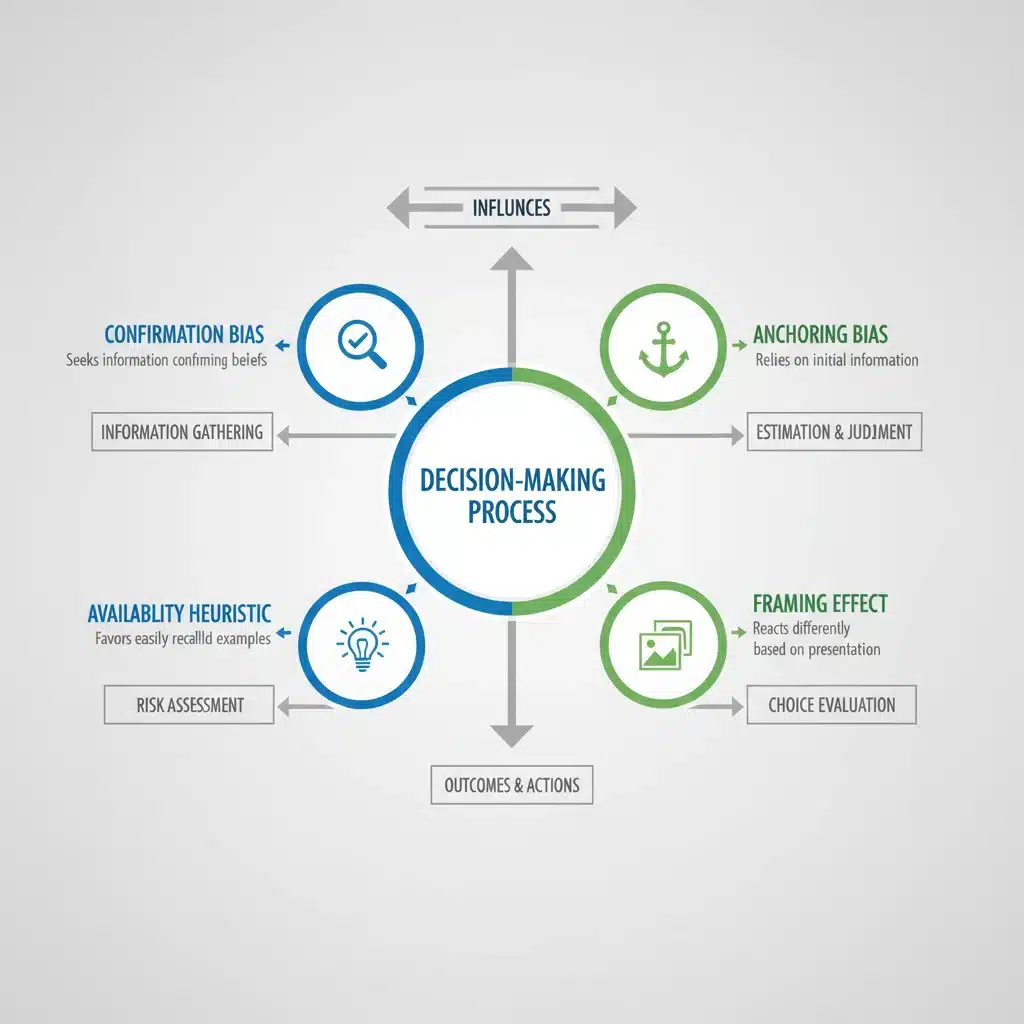
Action Item: Create a ‘Bias Bingo’ card or a checklist of these biases. Actively look for them in meetings, project discussions, and even personal decisions. Share your observations (anonymously if necessary) with a trusted peer or mentor to gain different perspectives on how these cognitive bias strategies play out.
Week 3: Self-Assessment and Personal Bias Inventory
Understanding biases intellectually is one thing; recognizing them in your own thought processes is another. This week is dedicated to introspection and self-assessment.
- Action Item: Utilize online self-assessment tools or quizzes designed to reveal your susceptibility to various biases. Be honest in your responses.
- Reflection: Review past decisions, both successful and unsuccessful. Could any of these outcomes be attributed to a specific cognitive bias? Document these instances and reflect on what triggered the bias.
Week 4: Team Dynamics and Group Biases
Biases don’t just affect individuals; they also manifest in group settings, sometimes even amplifying their effects. Explore common group biases.
- Groupthink: The tendency for cohesive groups to prioritize harmony and conformity, leading to irrational or dysfunctional decision-making.
- Bandwagon Effect: The tendency to do or believe things because many other people do or believe the same.
- Authority Bias: Attributing greater accuracy to the opinion of an authority figure (unrelated to its content).
Action Item: Observe team meetings with a critical eye. Identify instances of groupthink or authority bias. Discuss these observations (carefully and constructively) with a colleague to get a second opinion. Consider how these cognitive bias strategies might be subtly influencing your team’s collective outcomes.
Month 2: Strategies for Mitigation – Developing Countermeasures
Having identified common biases, the second month shifts focus to developing practical strategies and techniques to counteract their influence. This involves conscious effort and the implementation of structured approaches to decision-making.
Week 5: Cultivating Critical Thinking and Questioning Assumptions
At the core of bias mitigation is the development of strong critical thinking skills. This involves actively questioning assumptions, seeking diverse perspectives, and challenging the status quo.
- Action Item: Before making a significant decision, list all underlying assumptions. Then, actively seek information or perspectives that challenge each assumption. Practice the ‘5 Whys’ technique to get to the root cause of issues, rather than accepting surface-level explanations.
- Technique: Pre-mortem analysis. Before a project starts, imagine it has already failed catastrophically. Then, work backward to identify all the potential reasons for its failure. This helps uncover unforeseen risks and biases.
Week 6: Data-Driven Decision Making and Objective Metrics
One of the most effective ways to combat bias is to rely on objective data rather than intuition or anecdotal evidence. This week focuses on implementing data-driven approaches.
- Action Item: For key decisions, define clear, measurable criteria and gather relevant data. Avoid relying solely on ‘gut feelings.’ If a decision involves multiple options, create a scoring matrix based on objective metrics.
- Tool: Learn to use basic statistical analysis or data visualization tools to interpret information more objectively. Understand the limitations of data and avoid ‘data dredging’ to confirm existing beliefs, a common manifestation of cognitive bias strategies.
Week 7: Seeking Diverse Perspectives and Devil’s Advocacy
Exposure to different viewpoints can significantly reduce the impact of individual and group biases. Actively seeking out and valuing dissent is crucial.
- Action Item: In team meetings, assign a ‘devil’s advocate’ role to someone whose job it is to challenge assumptions and present counter-arguments. Encourage open debate and create a safe environment for dissenting opinions.
- Strategy: Actively build diverse teams with varied backgrounds, experiences, and thought processes. This inherent diversity can naturally mitigate many biases.
Week 8: Structured Decision-Making Frameworks
Implement formal frameworks to guide complex decisions, reducing reliance on intuitive, biased thinking.
- Action Item: Explore and adopt decision-making models such as the Cynefin framework for complex problems, or a simple pros and cons list that forces you to articulate arguments for and against a choice.
- Practice: For important decisions, write down your reasoning and the evidence supporting your choice *before* making the final call. This forces a more deliberate, System 2 approach and helps reveal potential biases in your initial thought process. This is a powerful way to counter many cognitive bias strategies.
Month 3: Reinforcement and Long-Term Integration – Sustaining Unbiased Thinking
The final month focuses on embedding these practices into your daily routine and organizational culture, ensuring that unbiased decision-making becomes a consistent habit rather than an occasional effort.
Week 9: Feedback Loops and Post-Decision Analysis
Learning from past decisions is vital for continuous improvement. Establish clear feedback mechanisms.
- Action Item: After a significant decision has been made and its outcome is known, conduct a ‘post-mortem’ (or ‘pre-mortem’ if you did that earlier). Analyze what went well, what could have been better, and critically, which biases might have influenced the process. Document these learnings.
- Practice: Regularly review your decision journal from Month 1. Are you seeing patterns? Are certain biases more prevalent for you? This self-awareness is key to refining your personal cognitive bias strategies.
Week 10: Fostering a Culture of Psychological Safety and Openness
Individual efforts are amplified when supported by an organizational culture that values critical thinking and challenges biases. This week addresses the broader environment.
- Action Item: Advocate for psychological safety within your team or organization, where individuals feel comfortable speaking up, challenging ideas, and admitting mistakes without fear of retribution. This is crucial for surfacing diverse viewpoints and combating groupthink.
- Leadership Role: If you are in a leadership position, model unbiased behavior. Actively solicit dissenting opinions, acknowledge your own biases, and reward critical thinking.

Week 11: Continuous Learning and Advanced Techniques
The world of cognitive biases is vast and ever-evolving. Maintain a commitment to continuous learning.
- Action Item: Explore more advanced behavioral economics concepts. Consider reading up on biases like the Dunning-Kruger effect, fundamental attribution error, or the endowment effect, which are often relevant in specific professional contexts.
- Resource: Attend webinars, workshops, or even consider a course on behavioral science or decision intelligence to deepen your understanding of cognitive bias strategies.
Week 12: Mentorship, Coaching, and Peer Accountability
Solidify your learning by engaging with others and building a support system.
- Action Item: Find a mentor or coach who can provide an objective perspective on your decision-making processes. Conversely, consider mentoring someone else and guiding them through the process of identifying and mitigating biases.
- Group Practice: Establish a peer accountability group where members regularly discuss challenging decisions, identify potential biases, and offer constructive feedback. This shared journey can significantly enhance your collective ability to implement effective cognitive bias strategies.