
In the high-stakes world of US business, every percentage point in a deal can translate into significant gains or losses. Imagine consistently securing an extra 10% on your deals, not through aggressive tactics, but by subtly influencing the psychological landscape of the negotiation. This isn’t wishful thinking; it’s the power of understanding and leveraging anchoring bias negotiation. This comprehensive guide will delve deep into this fascinating cognitive bias, providing actionable strategies for entrepreneurs, sales professionals, and business leaders to master anchoring bias and achieve superior outcomes in their US business negotiations.
Negotiation is an art and a science, a delicate dance of communication, strategy, and psychology. While many focus on logical arguments and data, the most effective negotiators understand the underlying psychological currents that shape decisions. One such current, often underestimated but profoundly impactful, is anchoring bias. By the end of this article, you will not only understand what anchoring bias is but also possess the tools to strategically deploy it, defend against it, and ultimately secure more favorable terms in your business dealings across the United States.
What is Anchoring Bias in Negotiation?
At its core, anchoring bias is a cognitive bias where an individual relies too heavily on an initial piece of information (the “anchor”) when making decisions. Once an anchor is set, subsequent judgments are made by adjusting away from it, but these adjustments are typically insufficient, meaning the final decision remains biased towards the initial anchor. In a negotiation context, the first offer made often serves as this powerful anchor, fundamentally shaping the perceived value and acceptable range for the entire discussion.
Consider a scenario where you’re selling a product. If you initially quote a price of $10,000, subsequent counter-offers will likely revolve around that figure, perhaps $8,000 or $9,000. If, however, your initial quote was $5,000, the negotiation range would shift significantly lower. The initial anchor doesn’t necessarily have to be a numerical value; it can be any piece of information that sets a reference point – a previous deal, a market standard, or even an aspiration. The critical takeaway is that this initial anchor disproportionately influences the final outcome, often without either party fully realizing its pervasive effect.
Research into anchoring bias dates back to the seminal work of Tversky and Kahneman in the 1970s, demonstrating how even arbitrary numbers can influence subsequent estimations. This robust psychological phenomenon is not limited to specific industries or cultures; it’s a fundamental aspect of human decision-making, making its understanding crucial for anyone involved in business negotiations.
Why Anchoring Bias is Crucial for US Business Deals
The US business landscape is highly competitive and often fast-paced, where quick decisions and firm stances are common. In such an environment, the ability to subtly guide the negotiation through psychological leverage like anchoring bias negotiation can be a game-changer. Here’s why it’s particularly vital:
- High Stakes: US business deals often involve substantial sums, long-term contracts, and critical partnerships. A 10% improvement due to effective anchoring can mean millions of dollars or years of successful collaboration.
- Competitive Edge: Many negotiators are aware of anchoring, but few master its strategic application and defense. Those who do gain a distinct advantage.
- Perceived Value: Anchors don’t just affect the price; they influence the perceived value of your product, service, or even your company. A high anchor can elevate the perception of quality and exclusivity.
- Efficiency: By setting a strong anchor, you can often streamline the negotiation process, narrowing the bargaining range and potentially reducing the time spent haggling.
- Psychological Framing: Anchoring allows you to frame the entire negotiation on your terms, shifting the focus to your desired outcome rather than reacting to the other party’s proposals.
In a culture that often values assertiveness and clear communication, understanding the subtle art of influencing perceptions through anchoring provides a sophisticated layer to your negotiation toolkit. It allows you to be both assertive and strategically nuanced, leading to more profitable and satisfying outcomes.
Strategies for Setting Effective Anchors
The key to leveraging anchoring bias negotiation lies in mastering the art of setting effective anchors. This isn’t about throwing out an arbitrary number; it’s about strategic preparation, confidence, and intelligent delivery. Here are proven strategies:
1. Do Your Homework: Research is Paramount
Before you even think about making an offer, thorough research is non-negotiable. Understand market rates, competitor pricing, your costs, your value proposition, and crucially, the other party’s likely budget, needs, and alternatives. A well-researched anchor is a credible anchor. If your anchor is perceived as unrealistic or unfounded, it can backfire, damaging your credibility and potentially alienating the other party.
2. Aim High (but Realistically)
The most effective anchors are often on the higher end of what’s reasonable, yet still justifiable. You want to pull the negotiation in your favor without appearing outlandish. If you’re selling, aim for an initial offer that is higher than your absolute desired price but still within the realm of possibility for the buyer. If you’re buying, aim lower. The goal is to establish a strong, favorable starting point from which adjustments will be made.
3. Be the First to Anchor (When Appropriate)
The party that makes the first offer often gains a significant advantage. This is because they set the anchor. However, this isn’t a hard and fast rule. There are times when it’s better to let the other party go first, especially if you lack sufficient information or suspect their anchor might be unreasonably low (if you’re selling) or high (if you’re buying). Generally, if you’re well-prepared and confident in your valuation, taking the initiative to set the anchor is a powerful move.
4. Justify Your Anchor
A naked anchor is less effective than a justified one. When you make your initial offer, immediately follow it with a clear, concise, and compelling rationale. Explain the value, the features, the benefits, the quality, the market conditions, or the costs that support your anchor. This justification reinforces the anchor’s legitimacy and makes it harder for the other party to dismiss it outright. For example, instead of just saying “We want $100,000,” say, “Given the premium features, our proprietary technology, and the projected ROI this solution offers, we’ve priced it at $100,000.”
5. Be Precise with Your Numbers
Interestingly, studies suggest that precise anchors (e.g., $9,875 instead of $10,000) can be more effective. A precise number can convey that you’ve done your due diligence, calculated carefully, and are confident in your valuation, making the anchor seem more legitimate and less arbitrary. This subtle psychological cue can enhance the perceived credibility of your initial offer.
6. Use Non-Monetary Anchors
Anchors aren’t always about price. You can anchor on other critical terms like delivery timelines, payment schedules, contract length, scope of work, or service level agreements. By anchoring these elements early, you can shape the overall framework of the deal in your favor. For instance, you might anchor on an aggressive project completion date, making other aspects of the negotiation seem more flexible in comparison.
Defending Against Opponent’s Anchors
While setting anchors is powerful, you’ll inevitably face situations where the other party sets an anchor first. Knowing how to effectively counter or neutralize an opponent’s anchor is just as crucial for successful anchoring bias negotiation. Here’s how:
1. Ignore and Re-Anchor (The Most Powerful Defense)
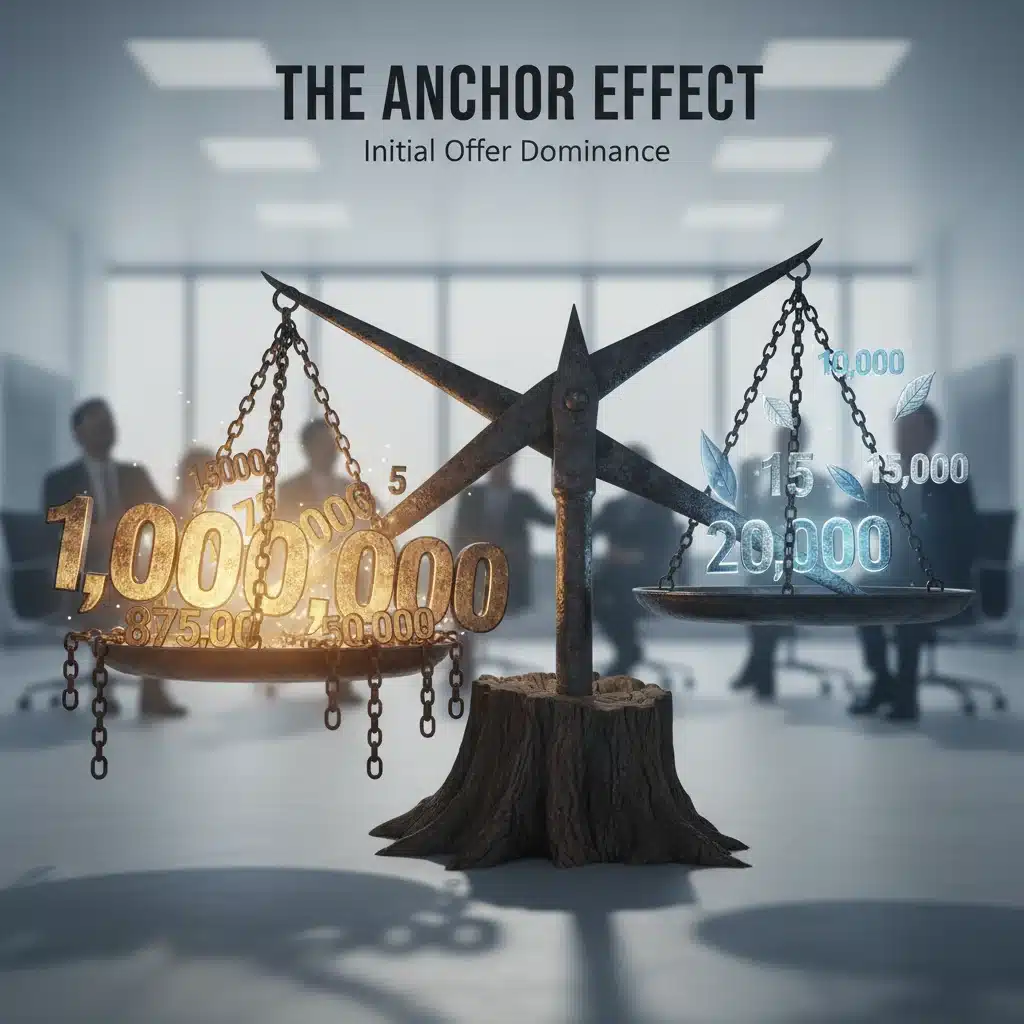
The most effective way to defend against an unfavorable anchor is to acknowledge it briefly, then immediately dismiss its relevance and set your own anchor. Do not dwell on their number or try to negotiate from it. For example, if a buyer offers a ridiculously low price, you might say, “I appreciate your offer, but that figure is far outside our expected range for a solution of this caliber. Based on the market value and the unique benefits we provide, we’re looking at a figure closer to X.” By doing this, you prevent their anchor from taking root and immediately shift the focus to your preferred range.
2. Call Out the Anchor
Sometimes, explicitly calling out the anchoring tactic can diminish its power. You might say, “That’s an interesting opening offer. It seems you’ve anchored quite low, which is a common negotiation tactic. Let’s discuss the true value here.” This can disrupt the psychological effect and force a more rational discussion.
3. Focus on Your BATNA (Best Alternative to a Negotiated Agreement)
Your BATNA is your power in any negotiation. If the other party sets an unfavorable anchor, remind yourself of your BATNA. Knowing you have viable alternatives empowers you to walk away or push back more forcefully, preventing you from being unduly influenced by their anchor. This internal anchor of your BATNA helps you maintain perspective.
4. Ask Diagnostic Questions
If an anchor seems unreasonable, ask questions to understand its basis. “Could you walk me through how you arrived at that figure? What assumptions are you making?” This forces them to justify their anchor, and often reveals weaknesses in their rationale, making their anchor less potent. It also gives you information to build your counter-argument.
5. Express Disappointment or Shock (Carefully)
A controlled expression of disappointment or even mild shock can signal that their anchor is unacceptable and needs significant adjustment. This must be done genuinely and professionally, not aggressively. “I must admit, that offer is considerably lower than what we anticipated for a project of this scope.” This subtly pushes them to reconsider their initial stance.
6. Shift the Focus to Value, Not Price
If the opponent anchors on a low price, pivot the discussion to the value, benefits, and long-term ROI of your offering. Emphasize how your solution solves their problems, saves them money in the long run, or provides a competitive advantage. This reframes the conversation away from their low anchor and towards the overall worth you bring to the table.
Practical Application: Securing 10% Better Deals
Now, let’s bring it all together. How can you practically apply anchoring bias negotiation to consistently secure 10% better deals in US business environments? It’s about a systematic approach:
Scenario 1: Selling a Service/Product
- Pre-Negotiation: Research competitor pricing, your unique value proposition, and the client’s budget range. Determine your ideal price (target), your walk-away price (BATNA), and a strategic high anchor (typically 15-20% above your target, but justifiable).
- Setting the Anchor: Be the first to make an offer. Present your high anchor confidently and immediately follow with a strong, value-based justification.
- Managing the Counter: If the client counters low, acknowledge their offer briefly, but immediately re-anchor by reiterating your value and your desired range. Do not adjust your initial offer too quickly.
- Strategic Concessions: If you need to concede, do so incrementally and always tie concessions to something in return (e.g., “We can offer a 5% discount if you commit to a longer contract term.”). This reinforces the value of your initial anchor and makes each concession feel earned.
- Aim for the 10%: By starting high and skillfully navigating the counter-offers, you increase the probability of the final price landing closer to your initial anchor, often resulting in a 10% or more improvement over what you might have achieved by starting lower.
Scenario 2: Buying a Service/Product
- Pre-Negotiation: Research market prices, your budget, and the seller’s likely pricing structure. Determine your ideal price, your walk-away price, and a strategic low anchor (typically 15-20% below what you expect, but justifiable).
- Setting the Anchor: If the seller hasn’t anchored, present your low anchor with a clear justification based on your needs, market comparisons, or perceived value.
- Managing the Seller’s Anchor: If the seller anchors high, politely dismiss it as outside your budget or market expectations. Immediately re-anchor with your justified lower figure.
- Focus on Value Reduction: If the seller is firm on their price, shift the discussion to what can be included or excluded to meet your budget. “At that price, what features or services can we remove to align with our budget of X?” This anchors on your budget as the new constraint.
- Achieving the 10%: By starting low and skillfully countering high anchors, you can pull the final price down closer to your initial low anchor, potentially saving you 10% or more.
Common Pitfalls and How to Avoid Them
While anchoring bias negotiation is powerful, it’s not without its risks. Avoiding these common pitfalls ensures your strategies remain effective:
- Unrealistic Anchors: Setting an anchor that is so outlandish it damages your credibility and shuts down the negotiation immediately. Always ensure your anchor is justifiable, even if aggressive.
- Lack of Justification: Presenting an anchor without a strong rationale. This makes it easy for the other party to dismiss your offer.
- Falling for Your Own Anchor: Believing your initial anchor so strongly that you become inflexible and unwilling to make reasonable concessions. Remember, the anchor is a strategic starting point, not an immovable object.
- Ignoring the Other Party’s Needs: Focusing solely on your anchor without listening to the other party’s interests and constraints. True negotiation involves finding common ground.
- Giving Too Many Concessions Too Soon: Undermining your anchor by making large, unjustified concessions early in the negotiation. Make concessions incrementally and strategically.
- Not Being Prepared for a Counter-Anchor: Being surprised when the other party sets their own anchor. Always anticipate this and have your re-anchoring strategy ready.
The Ethical Dimension of Anchoring
It’s important to address the ethical considerations of using psychological tactics like anchoring. While anchoring is a natural cognitive bias, its deliberate manipulation raises questions. The key is to use anchoring as a tool for fair value discovery and strategic positioning, not for deception or exploitation. Your anchor should always be justifiable, even if it’s on the higher side of your desired range. Transparency, honesty, and a commitment to mutually beneficial outcomes should always underpin your negotiation strategy. The goal isn’t to trick someone into a bad deal, but to ensure you are appropriately compensated for your value or to secure the best possible terms for your investment.
Advanced Tactics in Anchoring Bias Negotiation
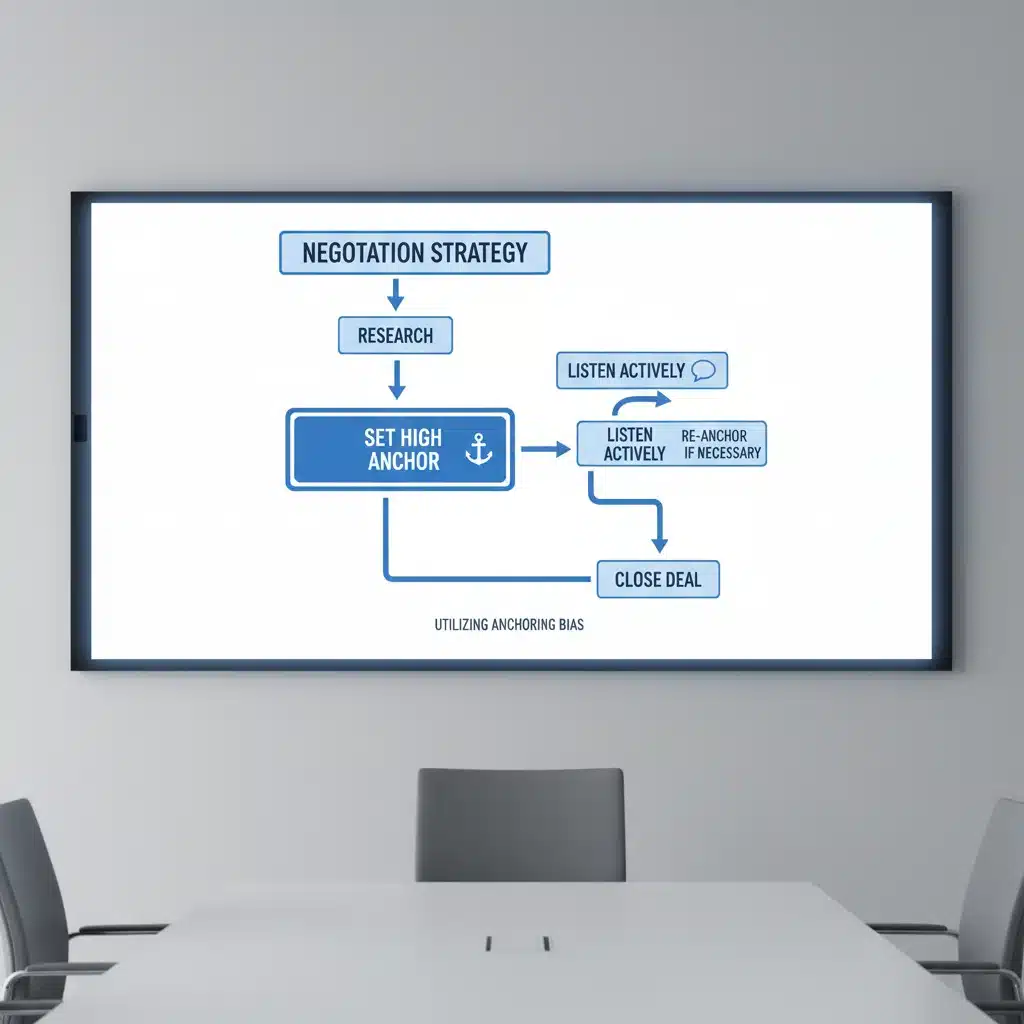
For those looking to deepen their mastery, consider these advanced tactics:
1. Multiple Anchors
Instead of a single anchor, you might present a range. For example, “For a solution of this complexity and the value it brings, we’re typically looking at an investment in the range of $90,000 to $110,000.” This still sets a high anchor but offers perceived flexibility, drawing the negotiation into your preferred upper range.
2. Anchoring on Extremes
Sometimes, an extreme anchor can be used to make your realistic anchor seem more reasonable by comparison. This is a high-risk, high-reward strategy. For instance, mentioning a competitor’s exorbitant price for a similar, but inferior, product before presenting your own competitive, yet still high, anchor. This creates a contrast effect.
3. Anchoring on Future Value
Beyond current price, anchor on the future value your offering will bring. “While the upfront investment is X, consider the projected 5-year ROI of 300% and the competitive advantage you’ll gain.” This shifts the focus from immediate cost to long-term gain, making the current price seem less significant.
4. Anchoring Through Third-Party Validation
Citing industry benchmarks, expert opinions, or prices paid by similar clients can serve as powerful, external anchors. “Our recent client, a company of similar size, invested X for a comparable solution, and they’ve seen Y results.” This leverages social proof to solidify your anchor.
5. Anchoring the Negotiation Process Itself
You can even anchor on the negotiation process. “Given the complexity, I anticipate this will be a detailed discussion requiring several meetings to cover all aspects.” This sets expectations for a thorough process, implying that a quick, lowball offer won’t suffice.
Conclusion: Make Anchoring Bias Your Strategic Ally
In the competitive US business environment, the ability to influence outcomes through psychological acumen is invaluable. Mastering anchoring bias negotiation is not about manipulation; it’s about understanding how human minds make decisions and using that knowledge strategically to achieve mutually beneficial, yet highly favorable, outcomes. By meticulously researching, confidently setting strong and justified anchors, and skillfully defending against those set by others, you can consistently elevate your negotiation results. The goal of securing 10% better deals is not just an aspiration but a tangible, achievable reality when you integrate these powerful anchoring strategies into your negotiation playbook. Start practicing, refining, and observing the profound impact of this cognitive bias, and watch your business deals transform.