Understanding Defaults: How Pre-Set Options Guide US Consumer Choices by Up to 25%

In the intricate tapestry of modern consumerism, every decision, no matter how trivial it might seem, is influenced by a myriad of factors. Among these, one stands out for its subtle yet profound power: the default option. For US consumers, these pre-set choices are not merely suggestions; they are powerful nudges that can steer behavior, often without conscious awareness. Research consistently shows that default settings can influence consumer choices by as much as 25%, sometimes even more, across diverse sectors from retirement savings to software installations and healthcare plans. This phenomenon, deeply rooted in behavioral economics, highlights a critical aspect of human decision-making: our inherent tendency to stick with the path of least resistance. Understanding the psychology behind consumer choice defaults and their widespread application is crucial for businesses, policymakers, and consumers alike.
The Psychology Behind Default Options: Why We Stick with the Status Quo
At the heart of the powerful influence of consumer choice defaults lies a fascinating interplay of psychological principles. Humans are, by nature, cognitive misers. We tend to conserve mental energy whenever possible, opting for shortcuts and heuristics over exhaustive analysis. Default options provide precisely such a shortcut. When faced with a choice, especially a complex one, the pre-selected option reduces the cognitive load required to make a decision. This phenomenon is often attributed to several key psychological biases:
1. The Endowment Effect
The endowment effect suggests that we value something more highly once we perceive it as ours. When an option is presented as the default, it can create a sense of ownership or possession, making us more reluctant to give it up. For instance, if a subscription service automatically enrolls you in a premium tier, you might feel a stronger attachment to the benefits of that tier than if you had to actively choose it from scratch.
2. Loss Aversion
Closely related to the endowment effect, loss aversion describes our tendency to prefer avoiding losses over acquiring equivalent gains. Opting out of a default can be framed, consciously or subconsciously, as losing something that was already ‘given’ to us. The potential ‘loss’ of convenience or perceived benefits by switching away from the default can outweigh the potential ‘gain’ of an alternative option.
3. Cognitive Friction and Effort
Making a different choice from the default often requires effort. It means gathering information, comparing alternatives, and actively changing a setting. This cognitive friction acts as a barrier. For many, the perceived benefits of switching might not outweigh the effort involved, leading to inertia. This is particularly true when decisions are seen as low-stakes or when consumers are overwhelmed by too many options.
4. Implicit Endorsement
Defaults can also carry an implicit endorsement. When a company or institution sets a particular option as the default, consumers might interpret this as a recommendation or a suggestion of the ‘correct’ or ‘best’ choice. This is especially potent when the source of the default is perceived as an authority or trustworthy entity, such as a government program or a reputable financial institution.
5. Bounded Rationality
Nobel laureate Herbert A. Simon introduced the concept of bounded rationality, suggesting that human decision-making is limited by the information available, the cognitive limitations of the mind, and the finite amount of time we have to make decisions. In this context, defaults serve as a practical mechanism to navigate a world brimming with complex choices, allowing individuals to make ‘good enough’ decisions without expending excessive resources.
Real-World Impact: Where Defaults Shape US Consumer Choices
The influence of consumer choice defaults is not confined to academic theories; it permeates countless aspects of daily life for US consumers. The 25% shift in behavior is a conservative estimate, with some studies showing even more dramatic effects. Let’s explore some prominent examples:
Retirement Savings: The Power of Automatic Enrollment
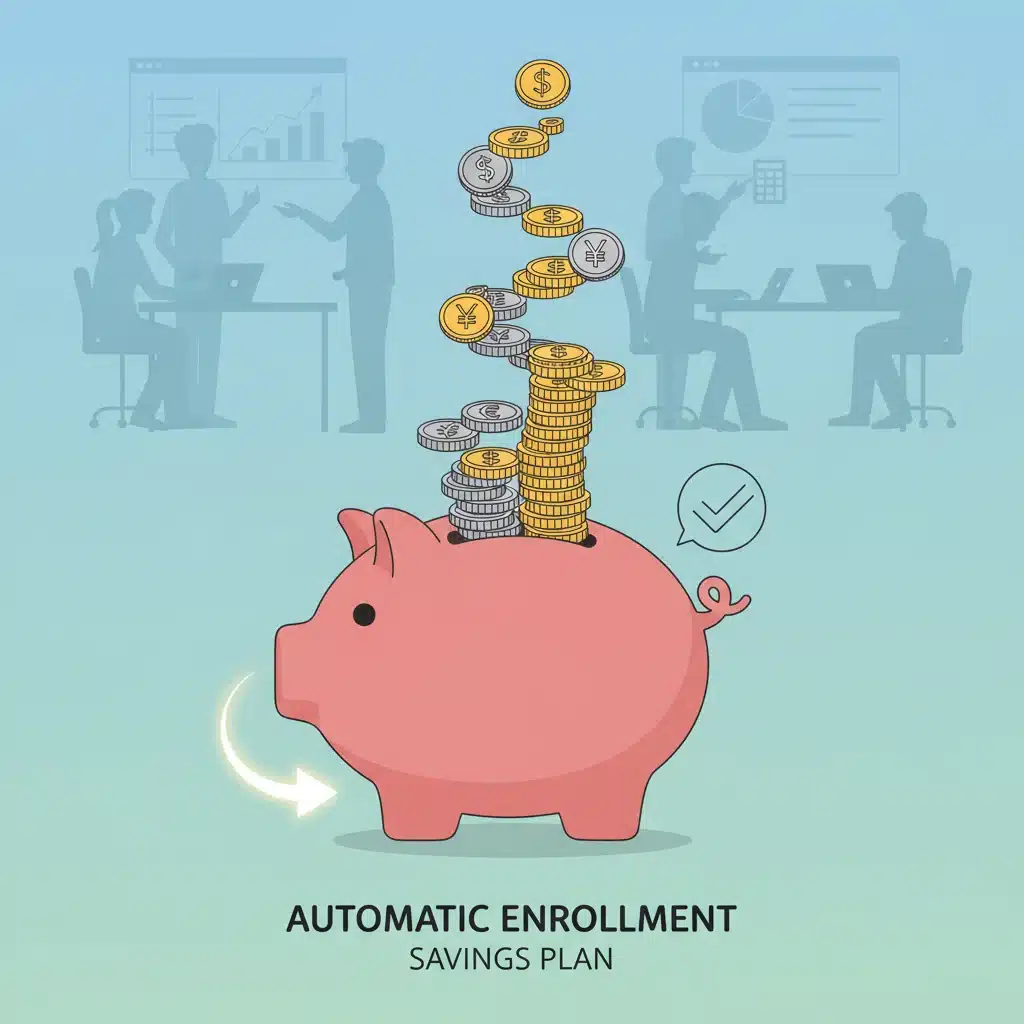
Perhaps one of the most well-documented and impactful applications of default settings is in retirement savings plans, particularly 401(k)s. Historically, employees had to actively opt-in to participate in their company’s retirement plan. This required filling out forms, choosing contribution rates, and selecting investments – a process that many found daunting, leading to low participation rates. The introduction of ‘automatic enrollment’ transformed this landscape. Instead of opting in, employees are now automatically enrolled in the 401(k) plan with a pre-set contribution rate and investment portfolio, with the option to opt-out. The results have been staggering. Studies by prominent economists like Brigitte Madrian and Dennis Shea have shown that automatic enrollment can increase 401(k) participation rates by as much as 30-50 percentage points, particularly among younger and lower-income employees. This subtle shift in the default has significantly boosted retirement savings for millions of Americans.
Healthcare and Organ Donation: Life-Altering Defaults
The impact of defaults extends to even more critical areas, such as healthcare decisions and organ donation. In many US states, individuals are presented with a choice to become an organ donor when applying for a driver’s license. The default option often requires an active ‘yes’ to opt-in. In contrast, some European countries operate on an ‘opt-out’ system, where citizens are presumed to be organ donors unless they explicitly state otherwise. The difference in organ donation rates between these systems is profound, with opt-out countries typically having significantly higher rates. This highlights how a simple change in the default can have life-or-death consequences.
Within healthcare insurance, plan selection can also be heavily influenced by defaults. When employers offer multiple health plans, the default option (often the one with the lowest premium or the most comprehensive coverage) tends to attract a disproportionately high number of enrollees, even if other plans might be better suited to individual needs. The complexity of comparing different plans makes the default an attractive, low-effort choice.
Software and Digital Services: Pre-Checked Boxes and Privacy
In the digital realm, consumer choice defaults are ubiquitous. Every time you install new software, sign up for an online service, or visit a website, you encounter pre-checked boxes and default settings that significantly impact your experience and privacy. Think about privacy settings on social media platforms, notification preferences, or whether your data is shared with third parties. Often, the most privacy-invasive or data-sharing options are set as the default, requiring users to actively navigate menus and uncheck boxes to protect their information. This ‘opt-out’ model leverages cognitive friction and user inertia to maximize data collection or feature adoption.
Energy Consumption: Green Defaults for a Sustainable Future
The concept of defaults is also being leveraged to promote sustainable behavior. In some utility programs, customers are automatically enrolled in ‘green energy’ plans, which source a percentage of their electricity from renewable sources, with the option to opt-out. Studies have shown that these ‘green defaults’ significantly increase participation in renewable energy programs compared to opt-in schemes, contributing to a more sustainable energy landscape. The slight increase in cost, if any, is often outweighed by the convenience of the default and the implicit endorsement of an environmentally friendly choice.
Product Customization and Upgrades
When purchasing a new car or configuring a computer, manufacturers often present a base model with certain features as default, then offer upgrades as optional add-ons. The default configuration sets a baseline expectation. Conversely, some online retailers automatically add certain accessories or extended warranties to your cart, requiring you to actively remove them if you don’t want them. This ‘opt-out’ strategy for add-ons can significantly boost sales of those items, leveraging the same psychological principles of inertia and loss aversion.
The Ethics and Implications of Default Settings
While the effectiveness of consumer choice defaults in guiding behavior is undeniable, their widespread application raises important ethical questions and implications. The power to influence decisions by up to 25% or more comes with responsibility.
Ethical Considerations: Nudging vs. Manipulating
The distinction between ‘nudging’ and ‘manipulating’ is a fine one. Proponents of default settings, often aligned with behavioral economics, argue that defaults are a benign form of ‘nudge’ that can help individuals make better choices, especially in complex domains like finance or health where optimal decisions are difficult. Automatic enrollment in retirement plans is a prime example of a ‘beneficial default’ that aligns with most individuals’ long-term interests.
However, critics argue that when defaults are designed to benefit the provider rather than the consumer (e.g., pre-checked boxes for marketing emails, automatic renewals for unwanted services), they can cross into manipulative territory. Consumers might feel exploited or that their autonomy has been undermined. Transparency is key here; clear communication about the default and easy options to change it are crucial for ethical implementation.
Policy Implications: Designing for Better Outcomes
Policymakers are increasingly recognizing the power of defaults to achieve public policy goals. From promoting health behaviors (e.g., default healthy food options in school cafeterias) to encouraging civic engagement (e.g., default voter registration), defaults offer a low-cost, high-impact tool. The challenge lies in identifying defaults that genuinely serve the public interest and ensuring that individuals retain the freedom to opt-out easily.
The rise of digital platforms also necessitates a closer look at ‘digital defaults.’ Regulations like GDPR in Europe and various state-level privacy laws in the US aim to give consumers more control over their data, often by requiring ‘opt-in’ for data sharing rather than ‘opt-out.’ This represents a conscious effort to shift the default towards greater privacy, recognizing the power of pre-set choices.

Empowering Consumers: Awareness and Agency
For consumers, understanding the pervasive influence of consumer choice defaults is the first step towards greater agency. By being aware that options are often pre-selected, individuals can cultivate a habit of critically reviewing default settings before accepting them. This critical awareness is particularly important in high-stakes decisions (e.g., financial products, healthcare plans) and in digital interactions where privacy is at stake. Tools and interfaces that make it easier for consumers to customize their choices and override defaults can also empower individuals.
Strategies for Businesses: Leveraging Defaults Responsibly
Businesses keen on influencing customer behavior can harness the power of consumer choice defaults, but they must do so responsibly and ethically. The goal should be to align company objectives with customer well-being, fostering trust and loyalty rather than resentment.
1. Understand Your Customer’s Best Interests
Before setting a default, businesses should ask: what option genuinely serves the long-term interests of the majority of our customers? For example, a default that helps customers save money or achieve a desired outcome (like a higher quality product or better service) is likely to be perceived positively. When the default benefits both the customer and the company, it’s a win-win.
2. Test and Iterate
The effectiveness of different defaults can vary significantly depending on the context, product, and target audience. A/B testing different default options can provide valuable insights into what works best. Businesses should analyze the impact of changes and be prepared to iterate based on customer feedback and behavioral data.
3. Ensure Transparency and Ease of Opt-Out
Ethical default design requires transparency. Customers should be clearly informed about what the default option is and, crucially, how to easily change it if they prefer an alternative. Hidden settings or complex opt-out processes can lead to frustration and erode trust. A prominent ‘change settings’ or ‘customize options’ button is essential.
4. Use Defaults for Socially Beneficial Outcomes
Businesses have an opportunity to contribute to societal well-being by implementing defaults that encourage positive behaviors, such as sustainable choices, charitable giving, or responsible consumption. This not only aligns with corporate social responsibility but can also enhance brand reputation.
5. Consider the ‘Active Choice’ Alternative
In some situations, rather than a default, an ‘active choice’ intervention might be more appropriate. This involves forcing individuals to explicitly choose between options, rather than having one pre-selected. While it might lead to lower participation rates for certain programs (like organ donation in an opt-in system), it ensures conscious decision-making, which can be important for highly sensitive or personal choices.
The Future of Defaults in a Data-Driven World
As technology advances and data analytics become more sophisticated, the application of consumer choice defaults is likely to evolve. Personalized defaults, tailored to individual preferences and historical behavior, could become more common. Imagine a streaming service that defaults your parental controls based on your viewing history, or a financial app that defaults your investment risk profile after analyzing your spending habits. While these personalized defaults could enhance user experience and lead to more relevant choices, they also introduce new layers of complexity regarding privacy, algorithmic bias, and consumer autonomy.
The ongoing debate around AI and automation will also touch upon defaults. As AI systems make more decisions on our behalf, understanding how their ‘default’ behaviors are programmed and whether they align with human values will be paramount. The future will demand a careful balance between the efficiency offered by intelligent defaults and the preservation of individual choice and control.
Conclusion: Navigating the Landscape of Pre-Set Choices
The pervasive influence of consumer choice defaults is a testament to the subtle yet powerful forces that shape human behavior. From boosting retirement savings to influencing our digital privacy and even our health decisions, these pre-set options can shift outcomes for US consumers by a significant margin – often 25% or more. Recognizing the psychological underpinnings of inertia, loss aversion, and cognitive ease allows us to appreciate why defaults are so effective.
For businesses, understanding and responsibly leveraging defaults can lead to better customer outcomes and stronger relationships. For policymakers, defaults offer a potent tool for achieving public good. And for consumers, an informed awareness of these subtle nudges is the key to exercising greater agency and making choices that truly align with their intentions, rather than simply following the path of least resistance. In a world increasingly filled with choices, mastering the art of the default – both as a designer and as a decision-maker – is an invaluable skill.